Climate Resilience: A critical Pillar of Data Centre Strategy
By Rubala Thangaraj, Senior Sustainability Advisor, The ESG Institute
For years, data centre sustainability has been measured primarily through efficiency: how much energy facilities consume, how effectively they use power and water, and how successfully they reduce carbon emissions. That definition is becoming too narrow. As AI, cloud computing and digital services accelerate demand for critical infrastructure, data centres are also being exposed to rising temperatures, water stress, flooding, grid instability and other physical climate risks that can directly affect uptime, asset value and business continuity. XDI estimates that 6.25% of global data centres are already at high risk from physical climate hazards, rising to 7.13% by 2050, or 27% when moderate-risk facilities are included. In this new issue of The Sustainability Gazette, Rubala Thangarajexplores why climate resilience must become a core pillar of data centre sustainability, how physical climate risk is reshaping design and investment decisions, and what operators, investors and business leaders can do to build digital infrastructure capable of performing reliably in a more climate-exposed world.
The sustainability challenge is changing
Every AI model, cloud application, digital payment and online public service depends on data centre infrastructure. As this dependence deepens, the sustainability debate is expanding beyond operational efficiency. Power Usage Effectiveness (PUE), Water Usage Effectiveness (WUE), renewable electricity procurement, low-carbon construction, waste management and uptime remain important. However, they do not by themselves show whether a facility can withstand the physical impacts of a changing climate.
The scale and speed of expansion make this distinction increasingly material. The International Energy Agency (IEA) estimates that global data centre electricity consumption could rise from about 485 TWh in 2025 to around 950 TWh by 2030, roughly doubling in five years. AI-focused data centres are expected to grow even faster, while higher rack densities and rapid power fluctuations place additional pressure on cooling systems, power equipment and local grids.
At the same time, physical exposure is increasing. XDI's 2025 Global Data Centre Physical Climate Risk and Adaptation Report estimates that 6.25% of global data centres are already at high risk from hazards such as flooding, extreme heat, fire, wind and soil movement. By 2050, 7.13% are projected to be at high risk, rising to 27% when moderate-risk facilities are included. The report also finds that targeted structural adaptation could materially reduce the number of high-risk facilities.
The strategic implication is clear: sustainable data centre design must incorporate physical climate risk and adaptive capacity from the outset. Climate resilience is not a separate engineering issue. It is a business continuity, asset valuation, customer service and governance issue.
From efficient operations to climate-ready infrastructure
Traditional sustainability strategies often optimise performance against historical conditions. A PUE target, for example, may demonstrate efficient energy use during normal operations but say little about how the facility performs during a prolonged heatwave, regional drought, flash flood or grid emergency. Climate change weakens the assumption that past weather is a reliable design baseline.
A forward-looking approach assesses both acute hazards, such as storms, wildfires and floods, and chronic changes, including higher average temperatures, sea-level rise, water scarcity and declining grid reliability. It then tests how those hazards affect cooling capacity, electrical redundancy, fuel and water supply, network connectivity, staff access and the availability of replacement equipment.
Table 1. How physical climate risks translate into operational and financial impacts
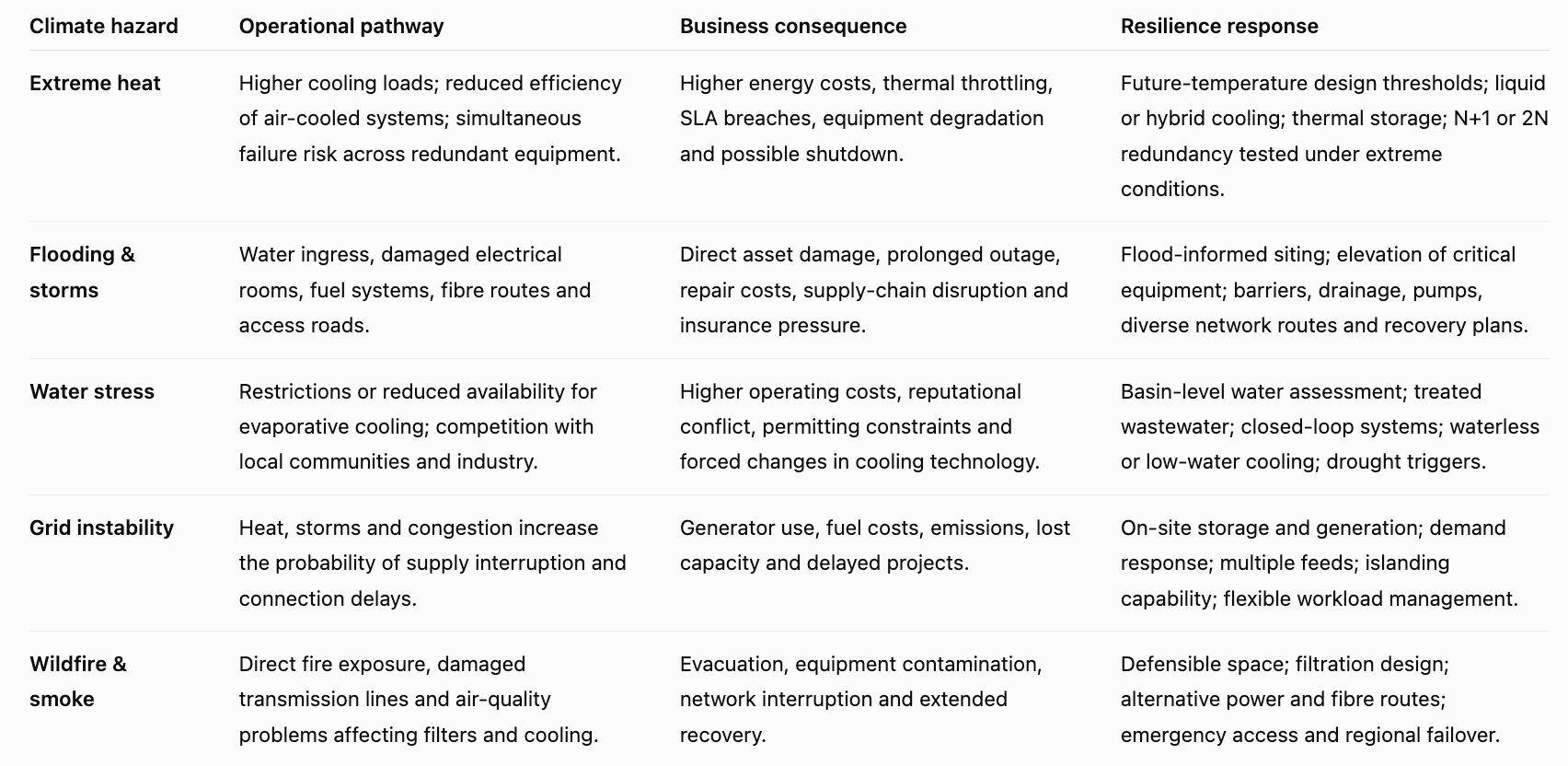
The purpose of this assessment is not to predict a single future. It is to identify failure thresholds, dependencies and no-regret investments across a range of plausible scenarios.
Heat, water and power are increasingly interconnected
Extreme heat illustrates why efficiency and resilience cannot be separated. Higher ambient temperatures increase cooling demand precisely when electricity networks may also be stressed by air-conditioning loads and heat-related equipment failures. During the United Kingdom's 40°C heatwave in July 2022, cooling failures affected major cloud infrastructure in London, including Google and Oracle facilities. The event showed that nominal redundancy can still fail when multiple systems are exposed to the same environmental condition.
Water presents a similar systems challenge. S&P Global analysed 9,055 data centres and found that 43% operate in areas of high water stress in the current decade. Under its slow-transition scenario, this rises to about 45% by the 2050s. The increase is modest globally, but location matters: exposure is particularly high in parts of the Middle East, southern Europe and Latin America. A facility with an efficient evaporative cooling system may therefore still face significant basin-level risk, community opposition or future restrictions.
Electricity availability is becoming a siting constraint as well as an emissions issue. The IEA estimates that around 20% of planned data centre projects could face delays unless grid integration risks are addressed. Because data centres are geographically concentrated, their local impact can be much greater than their global share of electricity demand. Ireland provides a visible example: data centres accounted for about 22% of national electricity consumption in 2024, demonstrating how quickly digital infrastructure can become material to grid planning and energy policy.
Embedding physical climate risk into design and investment
Climate-resilient design embeds risk assessment into site selection, engineering specifications, financing and operational management. This requires asset-level climate data rather than country-level averages, because flood, heat, wildfire and water conditions can vary significantly over short distances.
A robust process should test multiple time horizons and scenarios, including at least one high-emissions physical-risk scenario. It should identify the critical thresholds at which cooling performance, power availability, water access or physical protection become inadequate. The outputs should then inform capital allocation, procurement standards, insurance, business continuity and disaster recovery.
Resilience should also be assessed at system level. A facility may remain physically intact while losing its grid connection, fibre routes, water supply, fuel deliveries, workforce access or upstream cloud dependencies. For mission-critical services, geographic redundancy must therefore be evaluated against correlated regional hazards rather than distance alone.
Market examples: resilience in practice
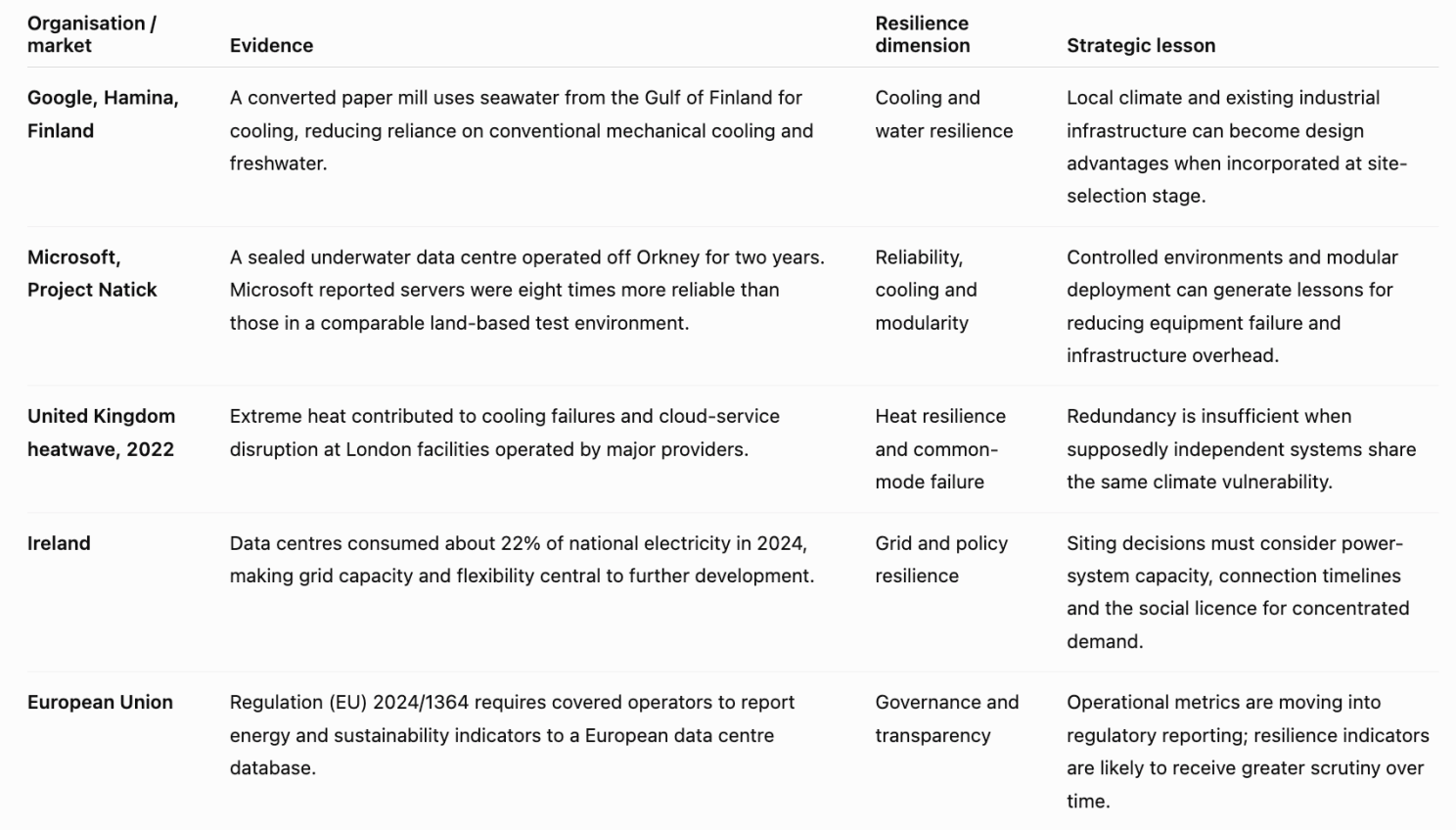
Table 2. Selected examples and the strategic lesson
The financial case: protecting value and reducing volatility
Physical climate risk becomes financially material through several channels: direct damage, business interruption, higher insurance costs, emergency capital expenditure, customer compensation, regulatory action and declining asset value. These impacts can be expressed through asset-level Value at Risk, expected annual loss, downtime scenarios and changes to discounted cash flow.
XDI uses Maximum-to-Date Value at Risk (MVAR) to express the probability of direct climate-related damage as a percentage of building replacement cost. For investors and lenders, this helps connect climate science to asset valuation. For operators, it supports prioritisation of adaptation measures according to avoided loss and service continuity.
Downtime reinforces the business case. Uptime Institute's 2024 analysis found that 54% of respondents said their most recent significant, serious or severe outage cost more than US$100,000, while 16% reported costs above US$1 million. Although not every outage is climate-related, extreme heat, storms, flooding and grid failures can increase both the probability and severity of disruption.
Resilience investments can therefore create value in at least four ways: reducing expected damage; protecting revenue and service-level performance; lowering the risk of premature obsolescence or stranding; and improving insurability and access to finance. The relevant question is not simply whether adaptation increases upfront capital expenditure, but whether the whole-life cost of inaction is greater.
From risk control to competitive differentiation
For customers running financial, healthcare, emergency, industrial or public-sector workloads, continuity under extreme conditions is a procurement issue. Operators able to demonstrate asset-level climate assessments, tested adaptation plans and transparent performance may be better positioned to retain customers, negotiate service terms and access insurance.
This creates a resilience dividend. Stronger design can reduce operational risk capital, protect asset values and support more stable long-term cash flows. It may also help operators differentiate facilities in markets where conventional efficiency metrics have become standardised.
However, resilience claims must be evidence-based. A credible proposition should disclose the hazards assessed, climate scenarios and time horizons used, critical thresholds identified, adaptation measures completed, residual risks and governance arrangements. Marketing language without quantified analysis risks becoming another form of greenwashing.
Governance and disclosure are catching up
Climate resilience is increasingly embedded in corporate reporting expectations. IFRS S2 requires companies to disclose information about the resilience of their strategy and business model to climate-related changes and to use climate-related scenario analysis to inform that assessment. The European Sustainability Reporting Standards similarly connect physical-risk assessment, scenario analysis, resilience and anticipated financial effects.
For data centre operators in the European Union, Commission Delegated Regulation (EU) 2024/1364 has introduced annual reporting of energy and sustainability information to a common European database. The indicators include energy consumption, power utilisation, temperature set points, waste-heat reuse, water use and renewable energy. Although the scheme is primarily performance-focused, it establishes a stronger data foundation for future benchmarking and policy.
Boards and investment committees should therefore treat climate resilience as part of enterprise risk management and capital planning. Accountability should extend across real estate, engineering, operations, procurement, sustainability, finance, insurance and technology teams.
A practical resilience framework
A data centre resilience programme can be organised around six questions:
Exposure: Which acute and chronic climate hazards affect each site, utility connection and critical supplier over the asset life?
Vulnerability: At what thresholds do cooling, power, water, access, communications or structural systems begin to fail?
Adaptation: Which engineering, operational or contractual measures reduce risk, and by how much?
Financial materiality: What are the expected losses, downtime costs, insurance implications and asset-value effects under each scenario?
Governance: Who owns the risk, approves investment and monitors residual exposure?
Disclosure and assurance: Can the organisation substantiate its resilience claims with traceable data, scenario assumptions and performance evidence?
Reframing sustainability for the climate era
The sustainable data centre of the future will not be defined solely by efficiency under normal operating conditions. It will be defined by the ability to deliver digital services reliably under climate stress while managing energy, water, carbon and community impacts responsibly.
As AI and cloud demand accelerate, this becomes a strategic priority. Facilities designed around historical weather and unconstrained utility assumptions may face rising operating costs, disruption and asset impairment. Those designed around forward-looking climate scenarios can protect continuity, strengthen customer trust and preserve long-term value.
Climate resilience should therefore be recognised as a foundational pillar of data centre sustainability, integrating climate science, engineering, financial risk management and governance. In an increasingly climate-exposed digital economy, the most sustainable data centres will not simply consume fewer resources. They will continue to perform when the systems around them are under pressure.
Stay Ahead of the Curve
At The ESG Institute, we empower professionals and organisations to navigate the world's evolving sustainability regulations with clarity and confidence. We do this through six core offerings: accredited education, training accreditation, advisory services, business verification, membership, and practical solutions.
Accredited Education Programmes span ESG strategy, sustainability reporting, carbon markets, climate law, sustainable finance, CSRD compliance, and sector-specific training. All fully online and CPD-accredited, they equip professionals with the practical tools to translate ESG insights into decision-ready outputs that boards, investors, and finance teams can act on. Learn more at www.the-esg-institute.org/training
Training Accreditation Service helps organisations, universities, training providers, and individual trainers achieve formal accreditation for their sustainability programmes. Our accreditation ensures training quality and professional recognition across four badge types: Accredited Professional Trainer, Training Institution, Programme, and Event. Apply at www.the-esg-institute.org/educational-accreditation
Advisory Services help organisations embed sustainability into corporate strategy, governance, and operations. From materiality assessments and ESG roadmaps to assurance and stakeholder engagement, we work alongside leadership teams to turn regulatory pressure into competitive advantage. Explore our 10-step sustainability roadmap at www.the-esg-institute.org/advisory
Certified Sustainable Business Verification independently assesses and certifies organisations across 50 criteria spanning environment, social, and governance. Our verification provides credible, third-party validation of ESG performance. Learn more at www.the-esg-institute.org/sustainable-business
Membership connects you with a global community of sustainability professionals. Choose from Alumni (free), Associate, Professional, Fellow, or Corporate tiers, each offering increasing levels of networking, mentoring, publishing, and advisory access. Join at www.the-esg-institute.org/membership
Solutions Platform, ESGtraordinary, connects organisations with curated third-party tools and services to accelerate their sustainability journey. Browse over 80 solutions at www.the-esg-institute.org/solutions
Join a growing community of over 20,000 sustainability professionals shaping a better future. For personalised guidance on integrating sustainability into your business operations, reach out to The ESG Institute. Our experts are here to help you navigate the complexities of ESG implementation and drive meaningful change. Contact us at team@the-esg-institute.org
References and further reading
1. International Energy Agency (2026), Key Questions on Energy and AI.
2. International Energy Agency (2025), Energy and AI.
3. XDI (2025), Global Data Centre Physical Climate Risk and Adaptation Report.
4. S&P Global Ratings, Beneath the Surface: Water Stress in Data Centers.
5. Uptime Institute (2024), Annual Outage Analysis 2024.
6. Google Cloud, GCP Arrives in the Nordics with a New Region in Finland.
7. Microsoft, Project Natick: Underwater Data Centres Are Reliable, Practical and Sustainable.
8. Central Statistics Office Ireland, Data Centres Metered Electricity Consumption.
10. IFRS Foundation, IFRS S2 Climate-related Disclosures and climate resilience guidance.