When ESG Stops Being a Story. How governance turns ESG into operational truth.

For years, ESG lived comfortably inside sustainability reports, corporate narratives, and carefully polished disclosures. That comfort is disappearing. As sustainability risks begin to affect enterprise value, investor confidence, operational resilience, and audit committee oversight, ESG claims now require evidence. Recent ESG market research found that 84% of S&P 500 companies identify sustainability-related issues as financially material, while only 1 in 5 finance teams currently report ESG metrics. In this new issue, Michelle Wicmandy, Senior Sustainability Advisor at The ESG Institute, explores how governance turns ESG from a story into operational truth, why fragmented data creates false confidence, and what boards, executives, finance teams, and audit committees must do to build disclosures that can withstand scrutiny.
Data keeps moving
beneath polished reporting
while trust starts drifting.
ESG reporting is entering a new phase. The question is no longer whether an organisation can tell a credible sustainability story, but whether it can prove that its data, controls, governance, and disclosures are reliable under scrutiny.
For years, ESG conversations largely lived inside sustainability reports, corporate responsibility initiatives, and polished narratives. That is changing as sustainability risks increasingly affect enterprise value, operational resilience, financial reporting, access to capital, and investor confidence. Once those consequences become material, ESG moves from communications into governance oversight and, eventually, onto the audit committee agenda.
Financially material sustainability issues are now shaping enterprise governance. The growth of sustainability reporting among large companies is clear, with Governance & Accountability Institute research showing near-universal sustainability reporting among S&P 500 companies. Early CSRD reporting analysis has also found that 84% of reviewed companies disclosed at least one financially material sustainability impact.[1][2]
Yet operational readiness still trails governance expectations. Market analysis continues to point to weak alignment between finance and sustainability data, including the finding that only around one in five finance teams currently reports on ESG metrics. KPMG’s ESG Assurance Maturity Index similarly found that only 25% of companies felt they had the policies, skills and systems in place to be ready for independent ESG data assurance.[3][4]
That gap increases pressure on leadership to defend decisions under scrutiny when information across the business stops lining up. Weak controls, inconsistent data and fragmented reporting quietly erode governance visibility. Over time, they create one of the greatest governance risks organisations face: false confidence. When systems and functions stop talking to one another, leaders begin making decisions without seeing the full picture.
Once ESG enters the audit committee agenda, organisations move from story to infrastructure. Part of this shift is being driven by expanding reporting and standard-setting expectations worldwide. The European Union’s Corporate Sustainability Reporting Directive (CSRD), as amended by the EU’s Omnibus I simplification package, continues to raise expectations around disclosure quality, traceability, governance and assurance readiness for companies within scope, even as the revised rules narrow application thresholds and simplify certain reporting obligations. At the same time, ISSB-aligned reporting expectations are influencing how companies organise governance, strategy, risk management, metrics and targets. In the United States, the SEC’s climate disclosure rules remain legally and politically uncertain, with the SEC now proposing to rescind the 2024 rules in their entirety, making precise, jurisdiction-specific language important when referring to U.S. regulatory developments.[5][6][7]
Increasingly, sustainability information is being evaluated with the rigour historically associated with financial reporting. As governance expectations rise, sustainability disclosures move beyond stories toward operational evidence capable of withstanding scrutiny.
Governing the Claims
Sustainability disclosures are increasingly expected to withstand formal review, validation and assurance processes.
Recent work on sustainability assurance and audit quality indicators shows that ESG assurance is becoming central to audit oversight frameworks as regulators, investors and boards demand more reliable and defensible sustainability information. The shift is redefining auditors from traditional financial gatekeepers toward broader reviewers of operational and governance credibility.[8]
Once sustainability disclosures begin requiring formal assurance, the governance conversation quickly moves beyond reporting. The question is no longer: “Do we have sustainability goals?” It becomes: “Can we substantiate the data, controls and governance behind those claims?”
So, what happens when investors stop rewarding sustainability narratives and start demanding operational proof? Investor-facing expectations are moving toward fewer unsupported promises and more evidence tied to governance credibility, operational performance, risk exposure and capital allocation.
Regulatory frameworks are reinforcing the same trend. The CSRD has raised expectations around disclosure quality, traceability, auditability and assurance readiness. Following the adoption of the EU’s Omnibus I simplification package, the CSRD framework has also been amended in relation to scope, timing and reporting burden, although national transposition and practical implementation remain important for companies assessing their obligations. Early CSRD reporting analysis also indicates that first-wave reporters have faced higher assurance and implementation costs, including reports of assurance cost increases of 30% to 50% for some organisations requiring limited assurance opinions.[2][5]
ESG starts operating less like messaging and more like operational oversight. As sustainability risks increasingly intersect with enterprise risk, capital allocation and disclosure expectations, governance expectations now reach deeper into operations, finance, reporting and leadership oversight.
Exposing the Gaps
Sustainability data rarely originates from a single function. Environmental metrics may sit inside operations. Labour disclosures may sit inside HR. Supply chain risks may sit inside procurement. Governance oversight may sit inside legal, compliance or finance.
Problems emerge when those functions stop communicating. ESG rarely fails because organisations lack information. It fails when fragmented functions create governance dead zones where operational truth becomes trapped between teams.
KPMG found that 75% of companies were still not ready for ESG assurance across core areas such as governance, skills, data management, digital technology and value-chain readiness. That finding highlights how governance expectations continue to outpace operational readiness.[4]
Similar patterns appear in supply chain resilience research. A Maersk report, based on research with FT Longitude, quoted Chris Walker of Rolls-Royce warning that when “a single node” in the supply chain collapses, organisations may no longer be able to produce what they promised customers. The lesson is directly relevant to ESG governance: where operational dependencies are invisible, risk oversight becomes incomplete.[9]
Closing the Gaps
Some organisations are already embedding sustainability more directly into operational governance systems.
Unilever has linked elements of executive remuneration to sustainability performance targets, reinforcing accountability at leadership level. [10]
Apple extends sustainability oversight across its manufacturing ecosystem through its Supplier Clean Energy Program and supplier renewable electricity requirements, linking supplier engagement to operational emissions reduction. [11]
Clark Builders developed a formal ESG plan to integrate sustainability commitments into operational planning, workforce programmes and accountability structures across the business. [12]
Strong governance depends on consistency between:
operational reality
reporting processes
governance oversight
risk management
public disclosures
Closing those gaps requires more than stronger reporting. It requires systems capable of keeping information moving across the organisation.
Connecting the System
Governance problems rarely originate from a single disclosure or isolated reporting error. The Governance Integration Framework connects operational reality, reporting processes, risk management, leadership oversight and public disclosure into a coordinated oversight structure.
The framework reflects a growing governance reality: financially material ESG information rarely moves through a single department. It travels across operational, financial, legal, governance and reporting systems that must increasingly withstand scrutiny together.

Like a circulatory system, governance depends on information moving across interconnected functions. When that movement stalls, organisations begin losing trust in their own systems long before problems become visible externally.
Evolving Governance
The organisations adapting most effectively are not treating ESG as a parallel workstream. They are embedding it into enterprise risk management and internal audit processes, along with board reporting structures and executive accountability frameworks.
Boards increasingly influence sustainability outcomes through risk management, strategic direction and executive accountability. Research examining more than 6,000 firms across OECD countries found that audit committee expertise can strengthen the relationship between ESG performance and sustainable development outcomes, reinforcing the importance of experienced non-financial oversight.[13]
Governance expectations are also reshaping executive priorities. The Harvard Law School Forum on Corporate Governance has noted that leadership teams increasingly need to focus on resilience, measurable execution and credible delivery as ESG expectations mature.[14]
Governance begins where claims require proof. Mature governance systems depend on whether operational data, disclosures, controls and leadership oversight remain connected under pressure rather than functioning as isolated reporting activities.
The table below illustrates how governance systems evolve from fragmented reporting structures toward more connected oversight across finance, operations, legal, sustainability and executive leadership.
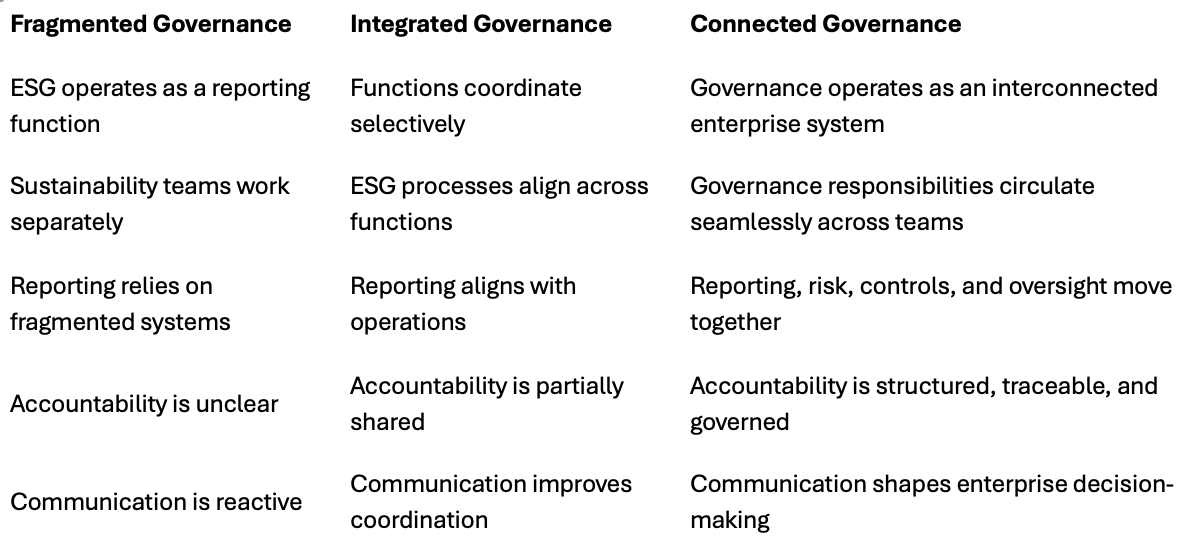
Mature governance systems are not defined by reporting volume, but by how effectively information, accountability and oversight remain connected under pressure.
What Changes On Monday Morning?
This is where governance conversations become operational. Once ESG enters audit committee oversight, organisations need to ask a different set of governance questions.
Where does financially material ESG data originate?
Map the operational systems, business units and functions responsible for generating sustainability-related information.
Who owns verification and escalation?
Define accountability for reviewing assumptions, validating metrics, managing inconsistencies and escalating material risks.
Are ESG disclosures connected to enterprise risk management?
If sustainability risks are financially material, they should connect directly into existing enterprise risk governance processes.
Can reported claims withstand assurance scrutiny?
Assess whether disclosures are supported by documented methodologies, controls, evidence trails and repeatable governance processes.
Does the board receive operationally meaningful ESG insight?
Boards increasingly require more than high-level sustainability summaries. Effective oversight depends on decision-useful information tied to enterprise risk, operational exposure and governance accountability.
Following the Signals
As ESG enters audit committee oversight, sustainability becomes less about standalone initiatives and more about whether the organisation can stand behind its disclosures and decisions.
Organisations recognising this shift early are better positioned to build governance systems capable of supporting long-term resilience and trust.
Once sustainability risks become financially material, ESG no longer sits adjacent to governance. It moves through the organisation itself, shaping how information travels, how decisions are defended, and whether trust continues to hold together when systems are tested.
Stay Ahead of the ESG Curve
At The ESG Institute, we empower professionals and organisations to navigate the world's evolving sustainability regulations with clarity and confidence. We do this through three core pillars: accredited education, strategic advisory, and practical solutions.
Our education programmes span ESG strategy, sustainability reporting, carbon markets, climate law, sustainable finance, CSRD compliance, and sector-specific training. All fully online and CPD-accredited, they equip professionals with the practical tools to translate ESG insights into decision-ready outputs that boards, investors, and finance teams can act on.
Our advisory services help organisations embed sustainability into corporate strategy, governance, and operations. From materiality assessments and ESG roadmaps to assurance and stakeholder engagement, we work alongside leadership teams to turn regulatory pressure into competitive advantage.
Our solutions platform, ESGtraordinary, connects organisations with curated third-party tools and services to accelerate their sustainability journey.
Learn more at www.the-esg-institute.org and join a growing community of nearly 20,000 sustainability professionals shaping a better future.
For personalised guidance on integrating sustainability into your business operations, reach out to The ESG Institute. Our experts are here to help you navigate the complexities of ESG implementation and drive meaningful change.
References
[1] Governance & Accountability Institute, Sustainability Reporting in Focus 2025
[2] DFGE, Trends in CSRD Reporting: Early Insights, Financial Impacts and Materiality Challenges, 2025
[3] KeyESG, ESG Statistics for Enterprises and Investors in 2026
[4] KPMG, ESG Assurance Maturity Index, 2023
[5] European Commission, Omnibus package, 2025
[6] U.S. Securities and Exchange Commission, SEC Votes to End Defense of Climate Disclosure Rules, 2025
[7] IFRS Foundation, Introduction to the ISSB and IFRS Sustainability Disclosure Standards
[8] CEAOB, Guidelines on Limited Assurance on Sustainability Reporting, 2024
[9] Maersk and FT Longitude, Mastering Supply Chain Resilience in an Unconventional World, 2025
[10] Unilever, Directors’ Remuneration Report 2025
[11] Apple, Environmental Progress Report 2024
[12] Clark Builders, Environmental Social Governance (ESG) Plan
[14] Harvard Law School Forum on Corporate Governance, Corporate Climate Disclosures and Practices, 2025