Companies spend significant time and resources mapping their material ESG risks. They survey stakeholders, build heat maps, and publish disclosures aligned to GRI, SASB, ISSB, and CSRD. Then, in most cases, nothing changes in the capital budget. PwC's 2025 Global Investor Survey confirms the disconnect: fewer than half of investors rely on materiality assessments to evaluate risk and opportunity. In this new issue, Michelle Wicmandy, Senior Sustainability Advisor at The ESG Institute, explores why materiality fails to move capital, identifies four structural barriers, and offers a practical toolkit for embedding material risks into the financial and governance decisions where outcomes are determined.
Materiality assessments are everywhere. Yet they rarely change what companies fund.
PwC's Global Investor Survey 2025 reinforces the gap. Most large companies conduct materiality assessments, but fewer than half of investors rely on them to evaluate risk and opportunity.
Capital is still moving toward sustainability. Morgan Stanley's 2025 Signals report shows that 84% of institutional investors expect to increase allocations to sustainable investments. Sustainability is influencing capital allocation decisions.
Companies map risks, rank priorities, and publish disclosures aligned to frameworks such as GRI, SASB, ISSB, and CSRD. But identifying what matters and acting on it are two different things.
In many companies, materiality and capital allocation operate in parallel but remain disconnected.
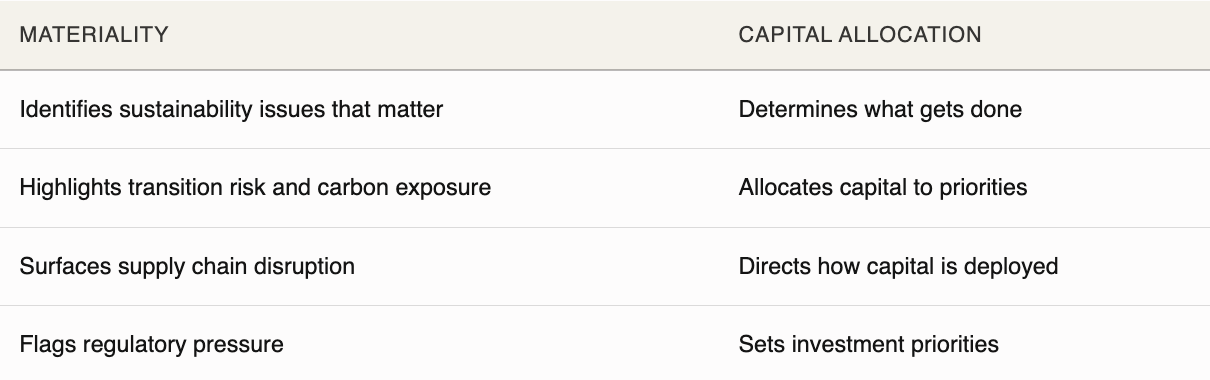
Materiality without integration is a diagnostic report without a treatment plan. The diagnosis is clear. The prescription is missing.
Reporting, Not Decisions
Materiality assessments were designed to prioritise issues based on stakeholder and financial relevance. They now function as compliance tools.
The gap is also a credibility issue. Nearly 94% of investors believe sustainability reporting contains unsupported claims. Disclosure alone does not provide information that finance teams, strategists, or boards can act on.
Typical outputs include stakeholder surveys, materiality heat maps, and high-level risk rankings. Materiality remains confined to reporting, with limited integration into investment memos, capital planning cycles, or board-level decisions.
Failure to Drive Action
The gap between disclosure and decision-making reflects four structural issues.
1. No Link to Financial Models
Material risks, such as transition risk, carbon exposure, and supply chain disruption, rarely enter discounted cash flow models, hurdle rates, or capital prioritisation decisions.
Executives are not dismissing sustainability. They lack decision-ready inputs and face competing capital demands and short-term performance pressures. Many material risks are long-term and uncertain.
2. No Clear Ownership
In many organisations, materiality is owned by sustainability or communications teams, while capital allocation sits with finance and executive leadership. This divide prevents material risks from entering financial decision-making.
3. No Governance Pathway
Boards review sustainability summaries, not the impact on capital allocation, financial risk exposure, or performance incentives. Yet they are increasingly held accountable for overseeing material risks under growing regulatory and fiduciary expectations.
Governance structures are beginning to evolve, but not in ways that consistently influence capital allocation. Approximately 77% of S&P 500 companies now incorporate ESG performance metrics into executive compensation, with adoption remaining stable. Companies are increasingly integrating ESG metrics across both short- and long-term incentive structures, reflecting an effort to bridge performance pressures and longer-term risks. That integration, however, does not consistently translate into capital allocation decisions.
4. No Financial Signal
Materiality fails when it does not create a financial signal. In well-functioning systems, signals trigger action.
Markets change behaviour when risks become financial signals. Carbon pricing provides a clear example. Assigning a cost to emissions converts risk into a financial liability within operating and capital budgets.
The gap between identifying risk and translating it into financial signals mirrors broader issues in carbon markets, where misaligned accounting distorts outcomes. Double counting shows how reported progress can diverge from real impact.
This is not a data problem. It is a decision architecture problem.
From Materiality to Capital Allocation: A Toolkit
To influence outcomes, materiality must be embedded into financial and governance decisions. Five actions form a practical approach.
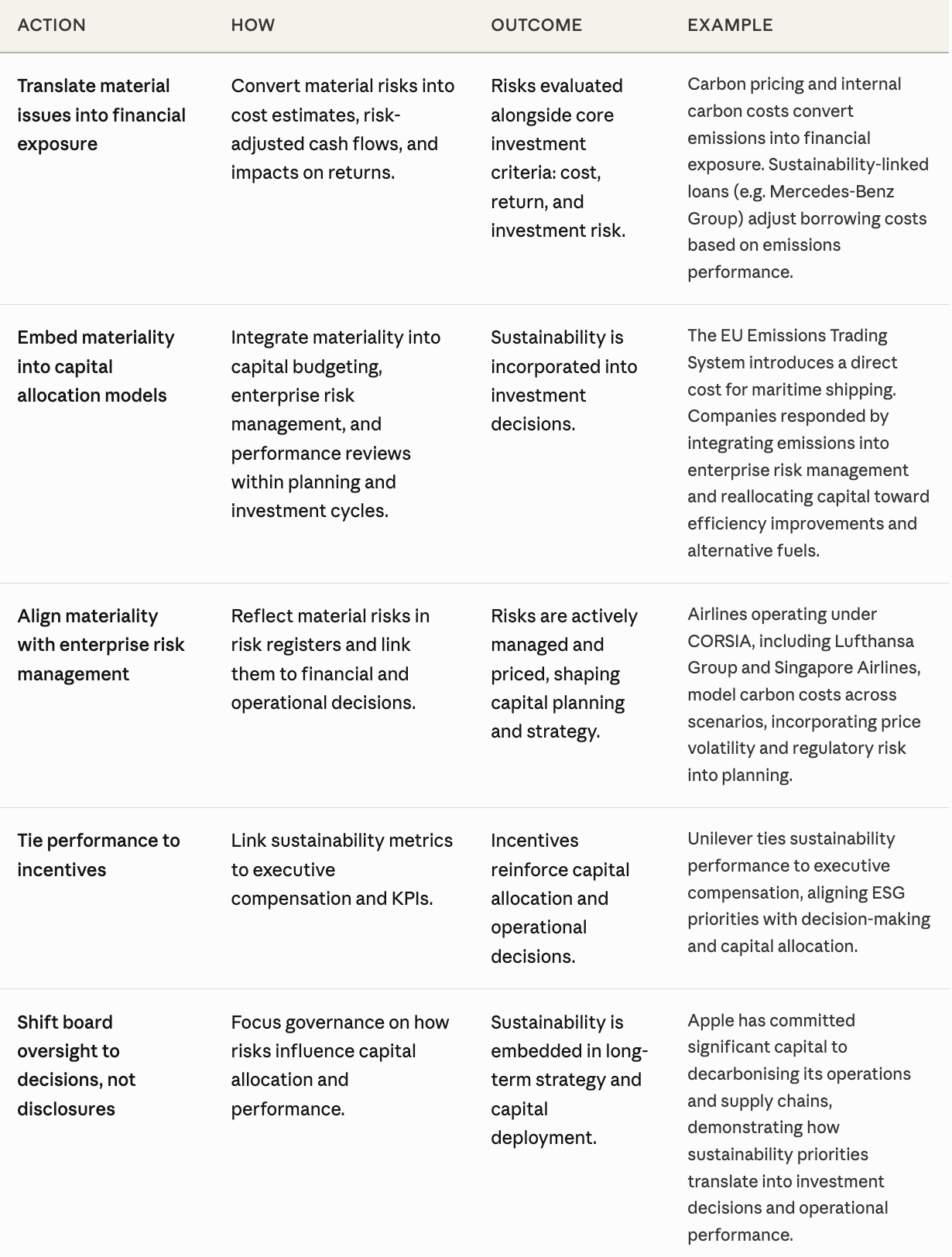
Financial markets are already reinforcing this shift by rewarding companies that translate sustainability into measurable performance and penalising those that do not.
The Bottom Line
Sustainability does not fail because leaders lack awareness. It fails in the gap between diagnosis and treatment.
The question is no longer whether an issue is material. The question is whether it changes a decision.
Until materiality influences capital allocation, it remains a narrative exercise.
Governance turns insight into action. Risk and return drive decisions. Capital drives outcomes.
Stay Ahead of the ESG Curve
At The ESG Institute, we empower professionals and organisations to navigate the world's evolving sustainability regulations with clarity and confidence. From ESG reporting frameworks and governance, to carbon markets, sustainable finance, and enterprise risk management, our accredited online programmes and advisory services are designed to turn compliance into opportunity.
Our programmes span ESG strategy, sustainability reporting, carbon markets, climate law, sustainable finance, CSRD compliance, and more, equipping professionals with the practical tools to translate materiality into the kind of decision-ready outputs that boards, investors, and finance teams can act on.
Explore our globally recognised diplomas and certificates, all fully online and CPD-accredited.
Learn more at www.the-esg-institute.org/training and join a growing community of over 10,000 sustainability alumni shaping a better future.
For personalized guidance on integrating sustainability into your business operations, reach out to The ESG Institute. Our experts are here to help you navigate the complexities of ESG implementation and drive meaningful change.